India just launched an AI that speaks 22 languages. Bhai, Urdu, Punjabi, Sindhi, Pashto and Balochi are still waiting.
26 billion parameters, government GPUs and every official Indian language. Here's what India actually built, what Pakistan has in the works, and what it would take to catch up.
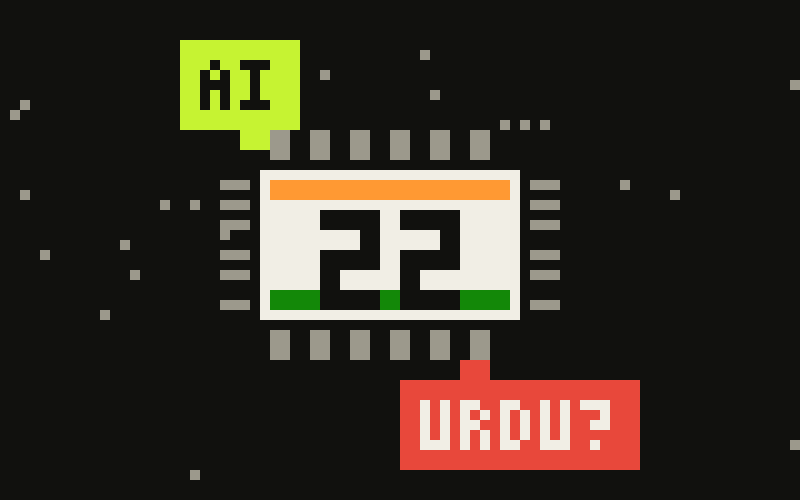
On 3 November, in New Delhi, India’s government stood on a stage and launched three homegrown AI models.
The big one is called EKA-1. It speaks all 22 of India’s official languages, plus English.
Meanwhile, ask most AI chatbots something in proper Sindhi or Balochi and watch them panic like a groom who forgot the rishta aunty’s name.
So, friendly neighbourhood question: what has India actually built, and where’s ours?
What India just launched
EKA-1, built by a startup called Soket AI Labs:
- 26.3 billion parameters. That’s the “brain size” of the model.
- Trained on about 7.5 trillion tokens of text.
- Speaks all 22 scheduled Indian languages + English.
- Built for maths, coding, reasoning and “agents” (AI that does tasks for you), with a focus on banking, finance and cybersecurity.
- Described as an open model.
They also launched two smaller models, Dhīr 2B and Dhīr 5B, from a startup called ZenteiQ. These are open source, cover English plus 10 Indian languages, and can run on a phone with no internet. Your data stays on your device.
The secret sauce: government GPUs
Training AI needs monster computers that cost a fortune. India’s trick is the IndiaAI Mission. The government picked startups and gave them subsidised access to national AI computing power, plus help with research costs.
India’s IT Secretary S. Krishnan said homegrown models will strengthen India’s “technological and strategic autonomy”. Translation: we don’t want to depend on American AI for everything.
OK, so where’s ours?
Here’s everything we could find:
1. Qalb: the student who went for it
In January 2026, Taimoor Hassan, a Pakistani Master’s student in the US, launched Qalb, which got called an “Urdu ChatGPT”. It was trained on about 2 billion tokens of Urdu and was built by him and two friends from his undergrad days.
Respect. But for scale: EKA-1 was trained on about 7.5 trillion tokens. That’s nearly 4,000 times more.
2. Jazz + NUST: announced in 2024
In November 2024, Jazz, NUST and the National IT Board signed a deal to build Pakistan’s first homegrown large language model. The focus is Urdu, with datasets for Pashto and Punjabi. Jazz said it was aiming for a working model “in the coming months”.
By August 2025 it was still in the foundation stage of collecting data, and senators were asking why other companies and universities weren’t invited. The IT ministry said no public money was involved. We couldn’t find a public launch since.
3. Buraq: the government’s own
In October 2026, the IT minister said Pakistan is building Buraq, an Urdu and regional-language AI model, and is buying “sovereign compute” so Pakistani data stays in Pakistan. No size, no launch date yet. The minister’s line: “AI is the last layer, not the first.”
4. PakGPT: coming soon
PakGPT says it’ll be a voice-first AI you can reach with a normal phone call, in Urdu, Punjabi, Sindhi, Pashto and Balochi. Its website calls it “soon-to-be-launched”. We’ll believe it when we can call it.
Why this matters more than you think
Here’s the stat that should wake everyone up. In the 2023 census, the share of Pakistanis whose first language is:
- Punjabi: 37%
- Pashto: 18%
- Sindhi: 14%
- Saraiki: 12%
- Urdu: 9%
- Balochi: 3%
So even a perfect Urdu AI misses most Pakistanis’ mother tongue. Your nani in Larkana, your chacha in Swat, the farmer in Bahawalpur who just wants to ask about wheat prices out loud: they’re the people who’d benefit most, and they’re the furthest from being served.
India didn’t out-code us. It out-organised us: GPUs, data and a plan, all in one place.
What it would actually take
- Data. Jazz said it plainly: collecting data is the biggest hurdle. We need huge amounts of written and spoken Punjabi, Sindhi, Pashto, Saraiki and Balochi. Think radio archives, PTV, court records, textbooks and WhatsApp-style voice notes, collected with permission.
- Compute. Shared, subsidised GPUs that universities and startups can actually use. That’s the IndiaAI playbook, and Buraq’s “sovereign compute” plan sounds like the start of it.
- Open models. Release the weights so a kid in Peshawar can build a Pashto tutor app on top. Closed models die in a ministry PDF.
- Voice first. Plenty of people talk to their phones more than they type. Speech matters more than chat.
The risks (yes, there are some)
- Big announcements, small results. We’ve seen “coming soon” before. Watch for downloadable models and real tests, not ribbon-cutting.
- Bad data, bad AI. A model trained on messy or biased text can confidently tell you rubbish in perfect Sindhi.
- Privacy. Keeping data “at home” only helps if the rules on who can use it are strong.
Friendly rivalry, nothing more: India is ahead on this one. The good news is the playbook is public. We just need to actually run it.
Sources: Analytics India Magazine, Inc42 and Digit on the IndiaAI launch (4 Nov 2026); The Nation and Arab News on Qalb (Jan 2026); The Fast Mode (Nov 2024) and Dawn (Aug 2025) on the Jazz–NUST project; Express Tribune on Buraq (Oct 2026); PakGPT’s own website; 2023 census figures via Wikipedia’s Languages of Pakistan page. We couldn’t find Soket’s own technical write-up, so EKA-1’s numbers are as reported at the government launch.
Not financial advice. We explain things; you make your own calls.